Thursday, September 28, 2006
Things to do in Hanoi
I found this list at the APEC Conference website, giving conference attendees the low-down on what to do while in town. Obviously, it's geared towards business visitors and polticos, but I thought it would be informative and valuable nonetheless. Because I expect to lose my bookmarks when transitioning overseas, I'm throwing it up here so I can find it again later on.


Monday, September 25, 2006
Everyone's an Expert, Part 2
Mel (Antidote to Burnout) in this post titled Looking for Expat Bloggers who Pose at Experts [sic] references the inquiry by CHarvey (CHarvey In Vietnam) seeking examples of what spurred me to write the Everyone's an Expert post below.
Instead of reinventing the wheel, I direct them to this Dealing with Negatives post by Jon Hoff (The Final Word).
On Mel's post, OMIH (Our Man in Hanoi) made, in part, these comments:
No, everyone is not right and not every opinion is valid and deserving of equal stature. One's opinion is formed from one's ability to observe (along, with other things, the knowledge with which to reflect upon such observations). But the ability to observe by the average expat is limited in many respects by the fact that that person cannot easily integrate and blend into the fabric of the world in which he is observing.
This reminds me of the Heisenburg Uncertainty Principle and its application in the social sciences. The observer, by virtue of observation, changes the observed. Within social sciences, observers seek to disappear into the background, to obtain a more valid observation.
How easily can a person who cannot converse in the local language, disappear and observe things as they are? It is not about self-censorship or omitting negative facts about Vietnam from one's opinions, it's about recognizing that writings which summarizes one's experience into the boilerplate of "Vietnam is ________" is a disservice to one's own experiences.
It's true that "blogs are blogs," but in this day and age, material on the internet serves as the authoritative guides and reference books for the world. How many people read books when such things are out-dated by the time they leave the printers?
As a group, expat writers who (mostly) write in English wield a not unsubstantial power to adjust the prism with which the English reading world views Vietnam, and other countries for that matter. As expats, the country is viewed thru the filter of the bubble that one luxuriates in. Expand the bubble in which one lives in, to expand the experiential basis for, and the validity of, one's comments.
Instead of reinventing the wheel, I direct them to this Dealing with Negatives post by Jon Hoff (The Final Word).
On Mel's post, OMIH (Our Man in Hanoi) made, in part, these comments:
Blogs are not 100% fact. They are opinions. That is the whole point of a blog. For VA to VN to complain about people having opinions on their blog is ludicrous. We all have opinions.To suggest that I am complaining about folks having an opinion is a straw man argument; to implicitly suggest that each and every point of view is equally valid stems from a juvenile canard that everyone, from their own perspective, is right.
...
Okay so we have shouldn't be too arrogant about what we present as fact. Especially when it's overly negative.
...
Blog are blogs. They are not guide books or reference books.
No, everyone is not right and not every opinion is valid and deserving of equal stature. One's opinion is formed from one's ability to observe (along, with other things, the knowledge with which to reflect upon such observations). But the ability to observe by the average expat is limited in many respects by the fact that that person cannot easily integrate and blend into the fabric of the world in which he is observing.
This reminds me of the Heisenburg Uncertainty Principle and its application in the social sciences. The observer, by virtue of observation, changes the observed. Within social sciences, observers seek to disappear into the background, to obtain a more valid observation.
How easily can a person who cannot converse in the local language, disappear and observe things as they are? It is not about self-censorship or omitting negative facts about Vietnam from one's opinions, it's about recognizing that writings which summarizes one's experience into the boilerplate of "Vietnam is ________" is a disservice to one's own experiences.
It's true that "blogs are blogs," but in this day and age, material on the internet serves as the authoritative guides and reference books for the world. How many people read books when such things are out-dated by the time they leave the printers?
As a group, expat writers who (mostly) write in English wield a not unsubstantial power to adjust the prism with which the English reading world views Vietnam, and other countries for that matter. As expats, the country is viewed thru the filter of the bubble that one luxuriates in. Expand the bubble in which one lives in, to expand the experiential basis for, and the validity of, one's comments.
Wednesday, September 20, 2006
Women in Vietnam
In this post by Mike Weston of the VN news aggregator blog Chao Vietnam (which means "Hello, Viet-Nam" fwiw), he posts an article by Tiền Phong that says Vietnam has one of the highest percentage of female legislators in Asia. It notes that "up to" 27.3 percent of "employees in legislative agencies" are females in Vietnam.
If taken at face value then there is a logical gap between the two sentences in the news article, after all "employees" are not exactly the same thing as legislators - for instance, there is a distinct difference between political staff and interns versus the elected or appointed legislator herself. Perhaps I'm reading the article too closely, so let me just assume that the article was loose with its language and indeed 27.3 percent of legislators in Vietnam are women.
27.3 percent is pretty stout and promising. In the U.S., according to information from this Rutgers link, women hold about 15% of the seats in Congress (and 14% in the Senate specifically), about 23% in state legislatures and 25% in statewide elective executive offices (attorney generals, comptrollers and the like).
So based on these raw numbers, it looks like women have similar, if not greater, poltical clout in Vietnam as compared to the U.S., a result one would not casually imagine based upon assumptions about Asian countries and societies. I guess that's the problem with casually assuming.
Within the private sector, the article notes that more than 22 percent of executives are women. The article is brief, or rather, lacking, in describing its survey methods and definitions, so it is difficult to compare it to U.S. statistics. Even so, comparing that number to the percent of women holding positions on the board of Fortune 500 companies (14.7 percent in 2005, an improvement from 9.6 percent in 1995 - according to this press release, summarizing a report conducted by Catalyst, a leading research and advisory company focusing on women in the workplace issues), shows that Vietnam is far from trailing.
Indeed, in our visit there, we met with a Vietnamese female executive that heads one of the biggest enterprises in the entire country.
So what does all this have to do with us? Well, to move there, VA will need to resign from her job and postpone her career - she loves the sector in which she currently works and is on a nice, upwardly mobile track at her organization. To give it all up is asking a lot (by me). To give it all up to move somewhere as a trailing spouse and be treated a bit like a second class citizen because she's a women would be a whole lot to take.
Maybe Vietnamese society is more egalitarian than we westerners give it credit for. The above stats help allay our concerns but our future experience will, in the end, determine how we perceive Vietnam on this metric.
Tuesday, September 19, 2006
Film Festival
Here's a shout out to my friends George and Gene at the San Diego Asian Film Festival, which is coming up in October. I met VA through Gene, so I'll always be in his debt.
Clickthru on this banner for the festival's site.
Clickthru on this banner for the festival's site.

Feed me
Nah, this isn't about food - though VA and I did go and grab some Vietnamese food with some friends the other day; we're trying to avoid Vietnamese food for the limited time we have left before heading overseas, but our friends won out.
This post is about that newly installed little orange icon on the right side of this page:

- it's courtesy of Feedburner and allows you, the avid gazer of this ditty, to add this to your feedroll.
I'm personally trying out the whole feed reader thing for the first time, because it's getting a bit tiresome to click on all the info blogs I attempt to read daily. I'm using a beta Google feed reader; probably there are better widgets for this function out there, but Google's services are rather integrated and sticky.
This post is about that newly installed little orange icon on the right side of this page:
I'm personally trying out the whole feed reader thing for the first time, because it's getting a bit tiresome to click on all the info blogs I attempt to read daily. I'm using a beta Google feed reader; probably there are better widgets for this function out there, but Google's services are rather integrated and sticky.
Wednesday, September 13, 2006
Granular pricing
Vietnam is ostensibly a communist country adopting a socialist market economy. I submit that - at least on the street level - it is neo-capitalist in my sense of the term. I know others have defined neo-capitalism for their own usage (see here and here); my definition of neo-capitalism is a market system that implements granular pricing.
Granular pricing is the ability to charge different consumers different prices for the same item. Here in the western world we have businessess and industries that exploit granular pricing. Ebay is a great example; so too is the auto industry, with price differentials for the same make and model across different dealerships. The consumer street scene in Vietnam and other less developed countries takes granular pricing to a whole next level - the ability to charge the same consumer different prices for the same item.
When I read bloggers and posters lamenting about being "ripped off" in their latest transaction I think, 'aha,' that's just neo-capitalism. As we all learned in Econ 101, for each product there is a supply-demand matrix. Vendors should assess this (macro-level) matrix in pricing their product. But what if the vendor has access to the supply-demand matrix on the micro-, individual level? With such information, wouldn't the transaction proceed more rationally and efficiently? After all, under the utilitarian view that undergirds the supply-demand curves, shouldn't a bottle of water be worth more to a thirsty person than a sufficiently sated one?
The street vendor (and you) suss out each other's curves through the act of bargaining. It's not an ideal method, but it works. So one day you may pay X for an item, the next X+ and the following X-. It doesn't mean that on some days you got taken and on others you did the taking; rather, the parties had different supply-demand matrices on the respective days and the item was priced accordingly. After all, in a fairly bargained transaction, neither party is ever "ripped off" - each should have extracted the maximal value from the other.
The only time that you are ripped off is when the cab driver drops you off across the street, just so that you cross an extra "zone" and therefore have to pay more. Oh wait, that's a D.C. phenomena.
So stop talking about being ripped off - if you don't like the price, then don't pay it and don't buy it. If someone tries to guilt or coerce you into paying for services not rendered, then stand up for yourself and don't pay them. If you paid more than you thought you should have, then that just means you're hungrier than you thought you were. And then marvel at getting a lesson in economics on the street.
Monday, September 11, 2006
It's all poltics to me
Five years. God damn. Eddie, I'm thinking of you and hope you and your family are doing o.k. today.
In other news, and upon reflection to Mel's comments, here's a picture of me and VA with some polticos - some Hanoi folks (ambassador to the US and 'mayor' of Hanoi):

And some American folks (Rep. Sherrod Brown (D-OH), seeking to depose Mike DeWine this November):
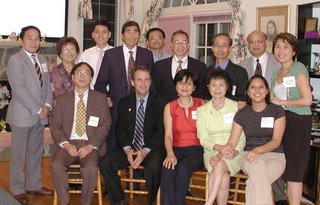
And all those Asian faces with Sherrod - don't fret, they're all Americans. No Al Gore-at-the buddhist-temple-flap here. Blondie, get your folks in Findlay to vote for this guy.
It's a tad ironic that in one frame I'm standing with some communist leaders, while in the other, I'm with one of the few congressional members who advocate a full recognition of Taiwan, in opposition to what the PRC wants. Life is complicated like that.
In other news, and upon reflection to Mel's comments, here's a picture of me and VA with some polticos - some Hanoi folks (ambassador to the US and 'mayor' of Hanoi):

And some American folks (Rep. Sherrod Brown (D-OH), seeking to depose Mike DeWine this November):

And all those Asian faces with Sherrod - don't fret, they're all Americans. No Al Gore-at-the buddhist-temple-flap here. Blondie, get your folks in Findlay to vote for this guy.
It's a tad ironic that in one frame I'm standing with some communist leaders, while in the other, I'm with one of the few congressional members who advocate a full recognition of Taiwan, in opposition to what the PRC wants. Life is complicated like that.
Friday, September 08, 2006
Busy bee
Thanks to this post by Mel on Antidote to Burnout, in reflection of the "Everyone's an expert" post below, this little blog has experienced a burst in traffic. It clearly demonstrates one truth - that Mel's blog is really darn popular.
It puts me a bit into a quandry though; I wanted to stick some pictures in here, as all this text dulls my eyes. There's a Hanoi-related picture of me that I wanted to put up for friends and family to see, but now that the audience is temporarily broader than that, I guess I will hold off. I'm weary of those internet stalkers that Dateline NBC and its ilk hypes all the time.
It puts me a bit into a quandry though; I wanted to stick some pictures in here, as all this text dulls my eyes. There's a Hanoi-related picture of me that I wanted to put up for friends and family to see, but now that the audience is temporarily broader than that, I guess I will hold off. I'm weary of those internet stalkers that Dateline NBC and its ilk hypes all the time.
Subscribe to:
Posts (Atom)

 subscribe to feed